Giving & Donating
What Happens to a Donated Sofa Between Your Door and the Shop Floor
A large donated item passes through collection, safety checks, storage, cleaning and pricing before anyone can buy it. Each stage costs money the donor never sees.

The points below about the handling chain behind a donated item are ordered by how much difference they make, not by how often they get repeated.
What matters most
- Collection is usually the largest single cost in the chain.
- Missing fire-safety labels can make upholstery legally unsellable.
- Unsold bulky goods leave the charity paying a disposal fee.
The van is the first cost
Furniture cannot be posted or dropped through a letterbox, so almost every large donation begins with a vehicle, a driver and usually a second pair of hands. A collection round is planned like a delivery route, and one address that turns out to be a third-floor flat with no lift can wreck an entire afternoon.
Charities that run collections screen by phone precisely because a wasted journey costs more than the item at the end of it is worth. This is why an apparently generous offer is sometimes declined, and why the refusal is rarely a judgement on the quality of the item alone. Delivering goods yourself removes the largest single cost in the chain, which is why drop-off donations are almost never turned away on logistics grounds.
Safety labels and legal resale
Some jurisdictions restrict the resale of upholstered furniture that cannot be shown to meet fire-resistance standards, usually evidenced by a permanent sewn-in label, and the rule is far stricter in some countries than others. A sofa whose label has been cut off may be legally unsellable in those places regardless of its condition, and shop staff have no discretion in the matter. Electrical goods face a parallel rule, with resale conditional on a documented safety test carried out by somebody competent to perform it.
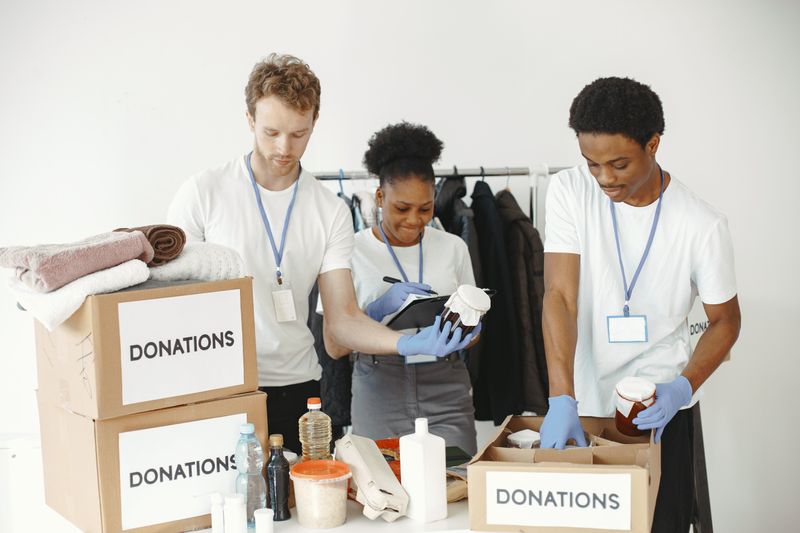
Sorting the donation bags, the exact standards and label wording differ by country, so a rule that binds a shop in one place may not apply a border away. Checking for the label before you offer an item saves everybody a journey and is the most useful single thing a furniture donor can do.
Storage is the invisible constraint
A shop floor holds perhaps a dozen large items, while a collection round can produce twenty in a morning, so the surplus has to go somewhere. Warehouse space costs rent whether or not anything sells from it, and a slow-moving wardrobe occupies that space for weeks at a time. Organisations therefore run informal stock limits, and an already overstocked category will be refused even when the individual item on offer is excellent.
The seasonal pattern is pronounced, with the weeks after new year producing far more donated goods than the retail demand of the same month can absorb. Timing a donation to the shop's quiet period rather than to your own clear-out materially changes how much it is worth to them.
Cleaning and repair
A steam clean, a replaced castor or a new zip can lift an item from unsellable to a viable price, and staff make that judgement in seconds. The labour involved is usually volunteer time, which is free in the accounts and very much not free in terms of what else could have been done.
Anything needing specialist repair is almost always declined, because the workshop capacity that would fix it simply does not exist in most shops. Items arriving genuinely clean skip this stage altogether and reach the floor within a day rather than a fortnight. A donor who washes a garment or wipes down a cabinet has effectively donated the labour as well as the object.
How a price gets set
Pricing balances what the item would fetch online, what the local customer base will actually pay, and how quickly the floor space needs clearing. Shops in wealthier districts price higher not out of greed but because their rent is higher and the stock arriving at the back door is better.
Over a funding cycle, anything unsold after a set number of weeks is usually reduced, then moved to a different branch, and finally written off. That markdown ladder is why the same sofa can be worth a substantial sum in one postcode and nothing at all a few miles away. A charity shop optimises for turnover rather than for value extraction, which is a genuinely different retail problem from the one a dealer solves.
Overhead ratios are a weak measure of a charity and a strong measure of its accounting.
The disposal end
Whatever fails to sell still has to be got rid of, and bulky waste disposal is charged by weight or by item in most places. A donation that ends at the skip has therefore cost the organisation the collection, the storage, the handling and finally the disposal fee.
Over a funding cycle, charities rarely say this out loud, because publicly refusing goods risks discouraging the donations they genuinely do want. The practical test is whether you would be willing to sell the item to a stranger, and whether you would be embarrassed when they arrived. If nobody would buy it, handing it to a charity mostly converts your disposal cost into theirs.
Everything above, in order of what to do first
- The van is the first cost. Furniture cannot be posted or dropped through a letterbox, so almost every large donation begins with a vehicle, a driver and usually a second pair of hands.
- Safety labels and legal resale. Some jurisdictions restrict the resale of upholstered furniture that cannot be shown to meet fire-resistance standards, usually evidenced by a permanent sewn-in label, and the rule is far stricter in some countries than others.
- Storage is the invisible constraint. A shop floor holds perhaps a dozen large items, while a collection round can produce twenty in a morning, so the surplus has to go somewhere.
- Cleaning and repair. A steam clean, a replaced castor or a new zip can lift an item from unsellable to a viable price, and staff make that judgement in seconds.
- How a price gets set. Pricing balances what the item would fetch online, what the local customer base will actually pay, and how quickly the floor space needs clearing.
- The disposal end. Whatever fails to sell still has to be got rid of, and bulky waste disposal is charged by weight or by item in most places.
The takeaway
The most useful furniture donation is clean, labelled, and offered in a month when the shop is empty.
Unrestricted money is the most useful gift and the least satisfying to make.
Questions readers ask
Why did a charity refuse furniture that was in good condition?
The usual reasons are a missing fire-safety label, an overstocked category, or a collection address the round cannot reach economically. It is rarely a comment on the item itself.
Is it better to sell something and donate the proceeds?
Often yes for anything with a strong resale market, since you capture value the shop would spend labour extracting. For bulky low-value goods the shop is usually still the better route.
Also by Tushar Jaiswal
- Why Fewer, Larger Donations Beat Spreading Money ThinlyGiving & Donating
- How to Read a Fundraising Appeal for What It Is Actually AskingGiving & Donating
- Why Charities Ask You to Confirm Your Tax StatusGiving & Donating
- Choosing Between a Cause Down the Road and One Far AwayGiving & Donating